 Xtremission LLC
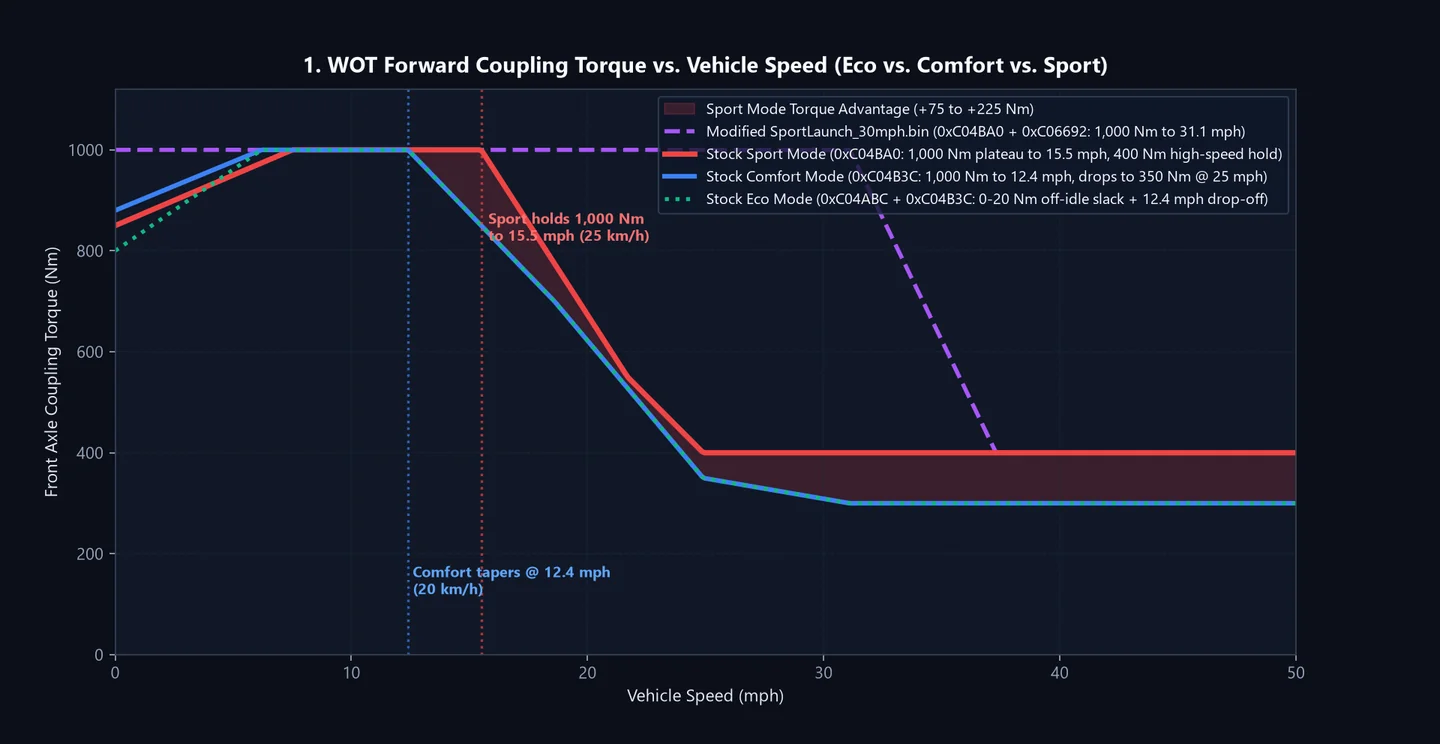
1. Settling the “Comfort vs. Sport” Launch Debate
The ROM tables explain why Stinger owners argue over whether Comfort or Sport hooks harder: both camps are feeling real differences in different parts of the launch.
Surprise #1: The 5 Per-Gear Standstill Launch Maps (0xC04598..0xC048B7) Are Identical in Stock ROM
There are five 16 Gear × 5 Pedal % ([10, 20, 30, 50, 80]%) launch preload tables in DPP1 (0xC04598 Mode 0 through 0xC04818 Mode 4). In stock calibration, all five modes are byte-for-byte identical:
- 1st Gear: [0, 200, 600, 1000, 1000] Nm
- 2nd Gear: [0, 130, 400, 650, 1000] Nm
Where Eco, Comfort, and Sport actually diverge is across four downstream calibration layers:
| Calibration Layer | ROM Address | Eco Mode | Comfort Mode | Stock Sport Mode | SportLaunch 30mph Mod |
|---|---|---|---|---|---|
| Off-Idle Base Preload (1st–2nd Gear) | 0xC04A3C / 0xC04ABC | 0–20 Nm (clutch pack slack) | 80–100 Nm (clutch pre-staged) | 80–100 Nm (clutch pre-staged) | 200–500 Nm (0xC04778 Mode 3) |
| Initial Front Split % (0–12 mph, No Slip) | 0xC0585A vs 0xC05922 | 45% (~810 Nm in 1st) | 45% (~810 Nm in 1st) | 40% rear-bias (~734 Nm in 1st) | 45%+ / Full 1,000 Nm Lock |
| WOT 1,000 Nm Speed Plateau | 0xC04B3C vs 0xC04BA0 | 0 – 12.4 mph (0–20 km/h) | 0 – 12.4 mph (0–20 km/h) | 0 – 15.5 mph (0–25 km/h) | 0 – 31.1 mph (0–50 km/h) |
| Forward Torque @ 18.6 mph (30 km/h) | 0xC04B3C vs 0xC04BA0 | 700 Nm | 700 Nm | 775 Nm | 1,000 Nm |
| Forward Torque @ 24.9 mph (40 km/h) | 0xC04B3C vs 0xC04BA0 | 350 Nm | 350 Nm | 400 Nm | 1,000 Nm |
| Part-Throttle (50% Pedal) @ 25 mph | 0xC04B3C vs 0xC04BA0 | 100 Nm (0 Nm at ≥31 mph) | 100 Nm (0 Nm at ≥31 mph) | 300 Nm (3× higher) | 750–800 Nm |
| Dynamic Torque Ceiling (High Speed) | 0xC059EA vs 0xC05A1C | Capped to 700–850 Nm | Capped to 700–850 Nm | Uncapped (900–1,000 Nm) | Uncapped (1,000 Nm) |
The Verdict on “Best Mode to Launch”
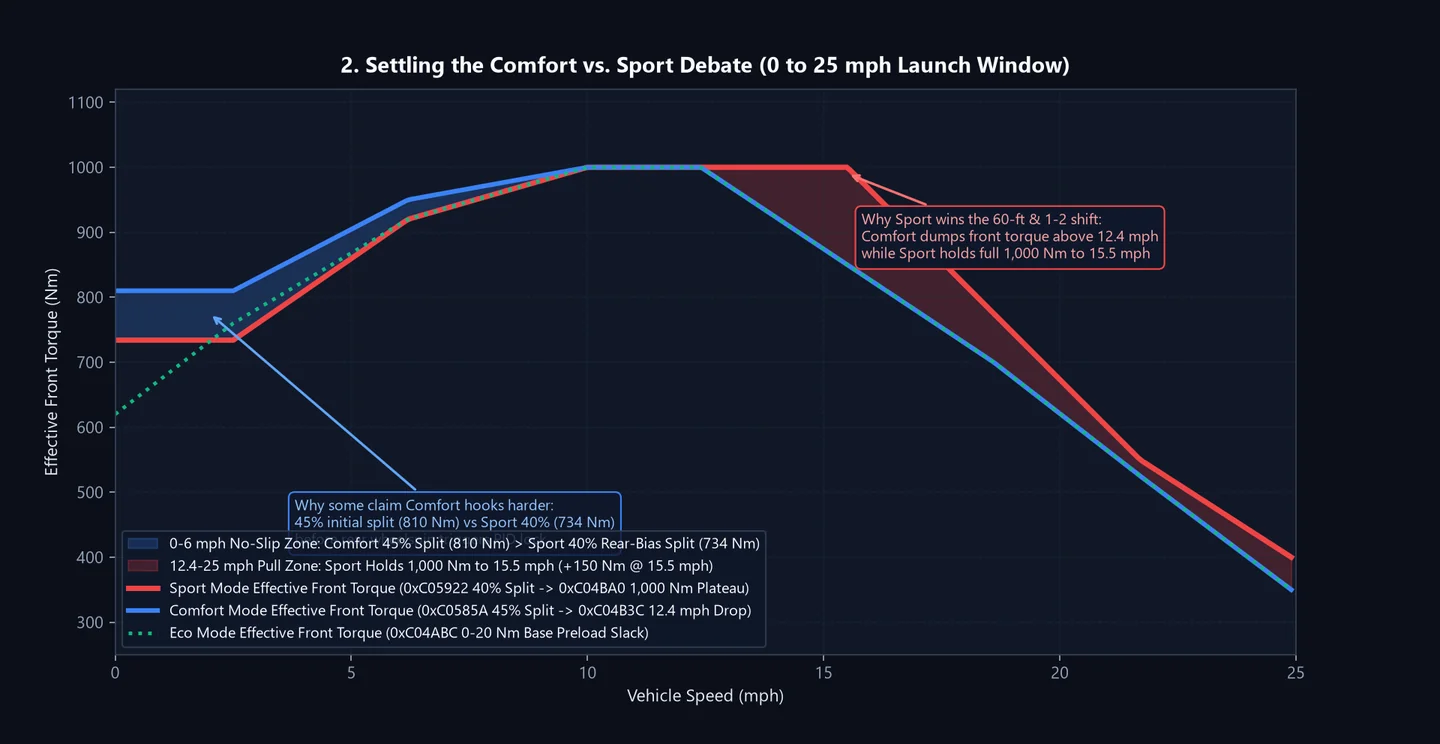
Why some drivers swear Comfort hooks better in the first 10 feet:
Standard WOT Launch Split matrices (#35–#38 at 0xC0585A..0xC058F0) command a 45% front torque split ([45, 45, 40, 31, 25]%), which equals ~810 Nm in 1st gear (1,800 Nm transmission output × 45%).
Sport's rear-biased split matrix (#39 at 0xC05922) drops initial front allocation to 40% ([40, 40, 40, 28, 20]% = ~734 Nm in 1st gear) so the car feels more agile, waiting for rear slip before adding PID feedback torque. On a marginal surface before slip occurs, Comfort puts +76 Nm more initial preload to the front tires from 0–10 mph.
Why Sport wins the 60-foot and 0–60 mph:
Comfort falls off a cliff at 12.4 mph (20 km/h): Its speed table (0xC04B3C, axis 0xC0667E) begins ramping front torque down immediately after 20 km/h, dropping to 700 Nm by 18.6 mph, 350 Nm by 24.9 mph, and 300 Nm by 31.1 mph (right in the middle of peak 1st-gear boost and the 1–2 shift!).
Sport holds the 1,000 Nm WOT plateau 25% longer (0–25 km/h / 15.5 mph) via 0xC04BA0 (axis 0xC06692), commands +75 to +200 Nm more forward torque all the way through the 1–2 shift, and keeps its high-speed ceiling (0xC05A1C) at 900–1,000 Nm instead of Comfort's 700–850 Nm cap (0xC059EA).
Why Eco is terrible for launching:
Eco slashes the off-idle base preload (0xC04ABC) in 1st gear from 80–100 Nm down to 0–20 Nm. Because the clutch pack starts completely slack, it takes longer to take up mechanical clearance when you mash the pedal, and then it still suffers from Comfort's early 12.4 mph torque taper.
2. How Brake-Boosting Affects AWD Engagement (Tab 3)
If you switch to Tab 3 (3. Brake-Launch Gate & Engagement), you can see the exact trap built into the stock AWD controller when brake-boosting on the line:
The 64.5 psi (4.45 bar) Brake Pressure Gate (0xC07498, 0xC07606, 0xC06068):
- The AWD ECU monitors master-cylinder brake pressure (
CYL_PRESon CAN ID0x220). - Whenever brake pressure exceeds 4.40–4.45 bar (63.8–64.5 psi), the launch inhibit logic forces 0 Nm coupling torque (clutch completely open, 100% RWD) to prevent drivetrain wind-up against the rear brakes.
What Happens During a Brake-Stand (t = -200 ms to 0 ms):
In our P-CAN log (phone_20261005/234311), holding the car stationary at 2,500–3,800 RPM requires 86–95 bar (1,250–1,380 psi) of brake pressure, more than 20× above the disengage gate.
As a result, across all 135 logged brake-boost samples on the line, _4WD11 (0x428) reports 0 Nm front torque (Status = 0x20 Normal Open). You are staging a boosted launch as a 100% RWD car.
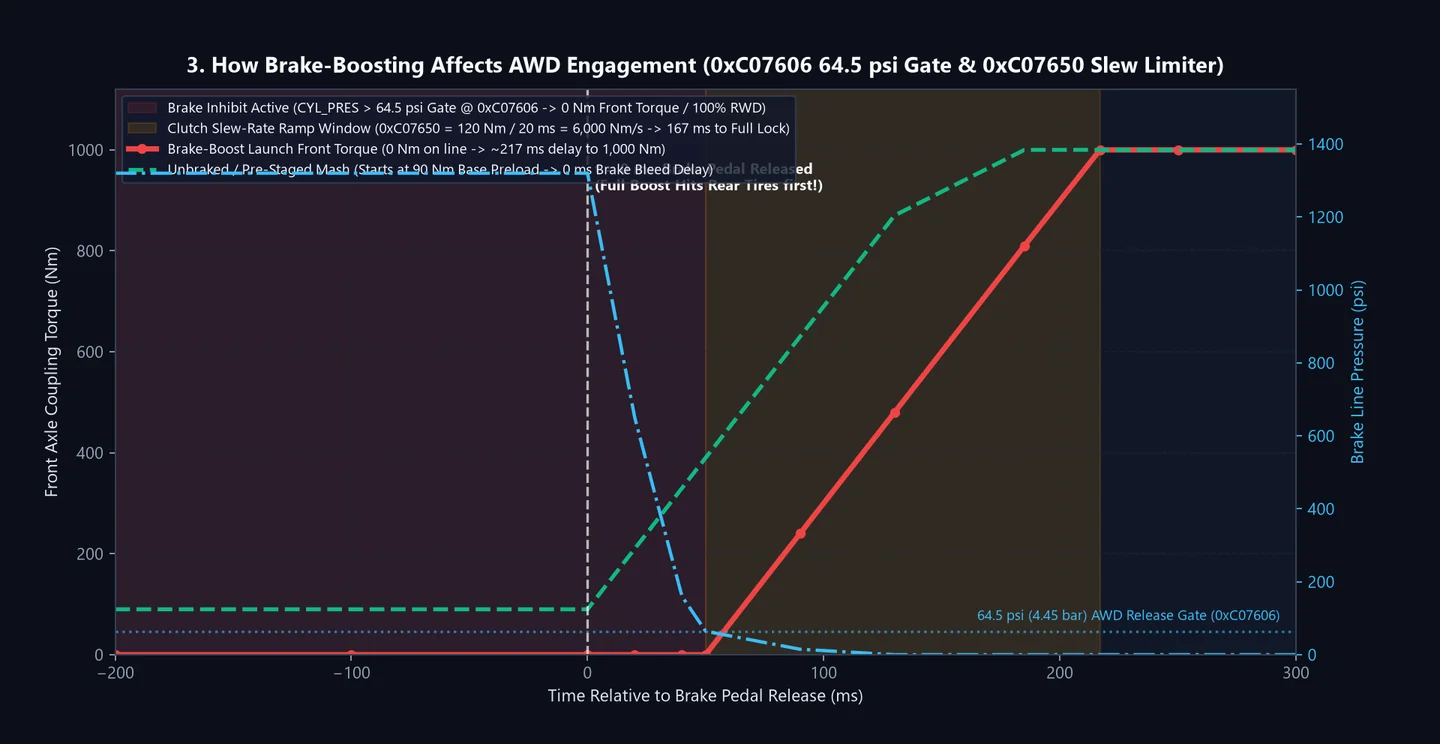
The ~185–215 ms RWD Wheelspin Window After Brake Release (t = 0 ms to +215 ms):
- 0 → +50 ms (Hydraulic Bleed Delay): When your foot leaves the brake pedal at t = 0, master-cylinder pressure takes ~50 ms to decay from 1,300 psi down below the 64.5 psi gate. The AWD clutch stays at 0 Nm the entire time the car begins to move.
- +50 → +215 ms (Clutch Slew-Rate Limit): Once
CYL_PRESdrops below 64.5 psi, the AWD ECU commands 810–1,000 Nm, but the Positive Slew Rate Limiter (0xC07650= 120 Nm per 20 ms = 6,000 Nm/s) limits how fast the solenoid can ramp. Reaching 810 Nm (45% split) takes 135 ms (+185 ms total); reaching 1,000 Nm full lock takes 167 ms (+217 ms total).
Because the turbos are already spooled on a brake-boost, full engine torque hits the rear tires at t = 0 ms while the front axle doesn't reach full lock until ~0.2 seconds later, which is why hard brake-boosted launches often shock-spin the rear tires before the front end pulls the car straight.
Related: Stinger AWD High-Speed Analysis, on why the AWD seems to disengage at 45 mph and what keeps it engaged past 140 mph.